Before Community Noticeboards, Local News Followed Familiar Routes
Before community noticeboards, local news moved through shop windows, meeting rooms and conversation. See how those familiar routes shaped neighbourhood connection.
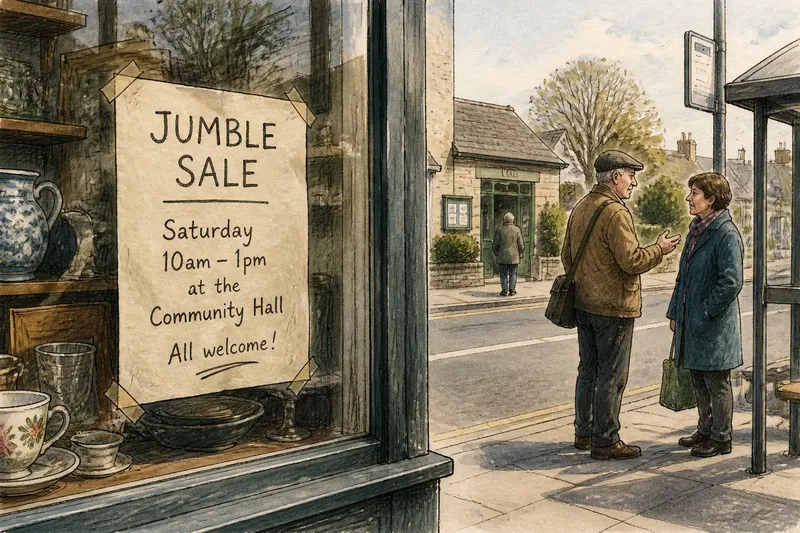
A handwritten jumble-sale notice sits in a shop window; across the road, someone mentions a meeting while waiting for the bus. Before community noticeboards, local news travelled through familiar places and conversations like these. The exact mix differed from one neighbourhood to another, but the principle was simple: information moved along the paths people already took.
Before community noticeboards, news moved with daily routines
A message might appear in a shop window, at a post office counter, on a meeting-room door or in a place of worship. These are examples of possible routes, not a single documented sequence: local habits and available gathering places varied. A person could encounter an announcement while running an errand, attending a meeting or stopping to talk.
Where a message appeared shaped who was likely to see it. A notice in a church vestibule could reach people who visited that church, while a market announcement might catch the attention of shoppers. Neither location automatically reached every neighbour. The audience followed the place.
Conversation carried news, too. A neighbour could explain a change or answer a question in the moment, but the message might travel only as far as that person’s contacts. A written note could stay put after its author left; spoken news could bring context that a few lines on paper could not.
Noticeboards gathered separate messages in one place
A shared board offered a recognisable spot where several announcements could sit together. Rather than asking which shop window held a particular flyer, a resident might be told to look at the board in a library or hall. That did not establish a universal historical turning point: boards appeared in different settings, and other ways of sharing news continued alongside them.
The change is easier to picture as a household pinboard enlarged for a shared space. It brings separate reminders together, but only helps people who can reach it and know where to look. The board is a point of reference, not a complete record of neighbourhood life.
Consider an invented situation: a residents’ group has previously mentioned its garden tidy-up only during a regular meeting. It pins a paper announcement on the board at the community hall, where visitors can see the date and meeting place. The expected observable result is that a person who did not attend the earlier meeting can read the invitation there; whether they join is a separate matter.
Place shaped who encountered local announcements
A board or loose notice could be visible yet still miss people who seldom used that building. A library, hall, shop or post office might each connect with a different set of visitors. Reading the history of local news-sharing means paying attention not just to the message, but to the route it took and the people likely to cross it.
These routes also affected how easily someone could follow up. A conversation offered a chance to ask the speaker for clarification. A notice gave a reader time to consider its details, but only if the writing was legible and the paper remained in view. Neither method was automatically better; each had its own limits.
What can a noticeboard tell us about earlier local news?
Did every neighbourhood share news in the same way?
No single pattern fits every place. Local customs, meeting points and the organisations people used shaped how an announcement travelled.
Why did people pass news by word of mouth?
Conversation fitted naturally into errands and social encounters, and it allowed questions or explanation. Its reach depended on who spoke to whom, so a message could remain within a familiar circle.
What did a noticeboard change?
A shared board gave written notices a common place to gather, rather than leaving each one at a separate venue. It did not replace conversations or reach everyone who lived nearby.
Can a noticeboard show who was included?
It can suggest which visitors were likely to encounter the messages, but it cannot establish who actually read them. The board’s location and the notice’s subject both matter when considering its likely audience.
Local news used overlapping routes
Shop windows, gathering places, spoken conversation and shared boards could all carry news at once. A person might hear about a meeting from a neighbour, then check a notice for the time or venue. Seeing these methods as overlapping routes avoids turning the story into a simple account of one tool replacing another.
For anyone exploring community noticeboards, that history offers a useful question: what everyday path made the information visible to its intended readers? A board is only one part of the answer. The places people visit, the conversations they share and the written messages they can return to all shape how neighbourhood news travels.