How a Local Tradition Can Change and Still Matter
Learn how a local tradition can change without losing its purpose, and use practical questions to decide what to keep, adapt or let rest.
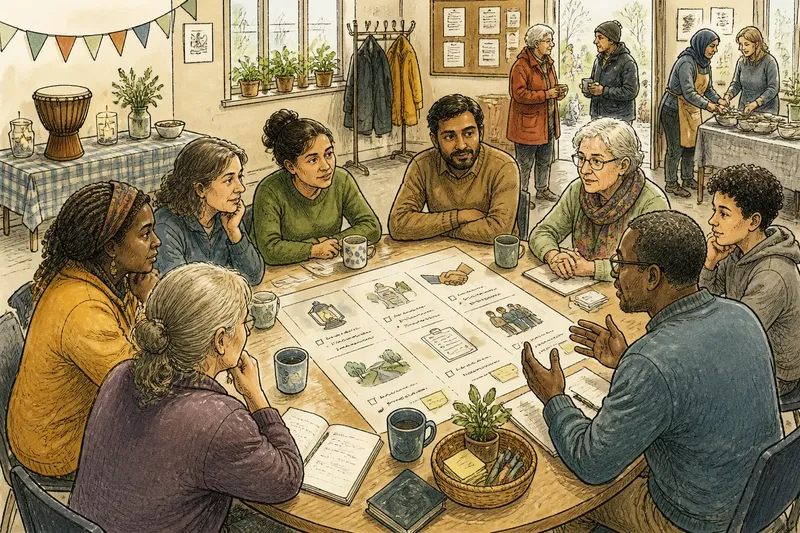
At the neighbourhood hall, the familiar brass bell is missing from the table. Its keeper cannot attend, and the bell is too delicate to pass around. Someone offers a hand drum instead; the pause before the shared meal remains, though its sound has changed. A local tradition can keep its meaning through a change like this, but only if the people involved can say what that meaning is.
A custom may mark a season, remember someone, welcome neighbours or give people a reason to meet. Its props and timetable matter, but they are not always the whole story. The useful question is whether people still recognise the purpose—and whether they have a fair chance to shape what happens next.
A local tradition can keep its purpose as its form shifts
Most customs combine a purpose, a familiar action, a place, a group of people and a shared understanding of the occasion. Some parts are easier to change than others. A procession might move from a road to a park while still bringing neighbours together; a particular song or object may carry memories that participants do not want to lose.
Think of a well-used recipe card. A handwritten substitution can change an ingredient without changing the meal’s place at the table. A custom works in much the same way, though a detail that seems incidental to one person may hold a memory or signal belonging to another.
Before deciding that an inherited feature must stay—or that a new idea is automatically better—ask what people would miss if the custom stopped, what they want preserved and which parts feel burdensome or exclusionary. Differences in those answers help explain the decision; they are not a reason to dismiss anyone’s view.
Choose whether to keep, adapt or pause a custom
Keep the familiar form when recognition matters
Some customs depend on a particular gesture, object or sequence because people have attached memories to it. A familiar song, shared route or named role can help neighbours recognise an occasion as theirs. Keeping the central feature may suit a custom that remains welcoming and workable, even if organisers change its venue or share out the preparation.
Preserving meaning does not require freezing every practical detail. A community might retain a central gesture while offering a quieter way to attend or a different place to gather. The distinction is between protecting what carries meaning and treating every arrangement as untouchable.
Adapt the form when the purpose still fits
Adaptation may suit a custom whose purpose remains valued but whose inherited format no longer works for everyone. A long outdoor walk, for example, could include a shorter route or a nearby stopping place. Discuss the change with people who rely on the custom, not only with occasional attendees looking for a convenient fix.
Say a neighbourhood holds a winter lantern walk up a steep hill, and several residents say the climb keeps them away. Organisers propose keeping the lantern-making and evening gathering, while adding a flatter route and a central place to join. They would then ask those residents whether the new arrangement let them take part in the parts they valued, and ask the wider group whether the seasonal gathering still felt recognisable. If either answer is no, they can revise the route or reconsider the plan rather than treating the first attempt as settled.
Let the custom rest when its purpose has faded
Not every tradition needs rescuing. If the people involved no longer value its purpose, or if continuing it depends on pressure and unpaid effort from a few, pausing may be more honest than preserving its shell.
A pause need not erase the story. People can record how the custom worked, ask former participants what they remember and leave room for a different gathering later. That preserves the account without pretending that a name alone keeps a tradition alive.
Use clear questions to decide what to preserve
Discuss the custom with organisers, participants and neighbours who have felt unable to join. Listen for the difference between “I prefer it this way” and “this part gives the occasion meaning”. Both views matter, but they point towards different choices.
- Purpose: Check whether people describe the custom’s purpose in similar or different ways. If accounts differ, record the disagreement and discuss it before changing the format; if they broadly align, use that shared purpose to guide the decision.
- Meaningful details: Ask which object, gesture, song or sequence carries memory. If a detail matters to participants, retain it where practical or explain why it may change; if no shared meaning is attached to it, consider adapting it.
- Access: Check whether timing, location, cost, physical access or social expectations keep neighbours away. If someone identifies a barrier, ask what would help and consider an alternative; if no barrier is raised, still leave a way for people to share concerns.
- Workload: Ask who prepares, hosts and clears up. If the same people feel stretched, share tasks or pause the custom; if people are willing to continue, make responsibilities clear rather than assuming someone will take them on.
- Review: Decide what participants will discuss after the next gathering, such as what felt familiar, what was difficult and who could take part. If the change serves the purpose and feels workable to participants, continue or refine it; if it does not, reconsider the format.
- Agreement: Check whether people understand what is changing and why. If important concerns remain unresolved, discuss a smaller change or a pause; if participants can explain the choice and its trade-offs, share the decision openly.
These questions separate continuity from mere repetition. A familiar format may be worth keeping, but habit alone is a thin reason if the custom no longer serves the people it is meant to bring together.
What should neighbours ask before changing a custom?
Should every part of a tradition stay the same?
No. Ask which details carry shared meaning and which reflect the way things have usually been done. Keep the distinction open to discussion: a small object or gesture can hold different memories for different neighbours.
Who should decide whether a custom changes?
Include organisers, participants and people affected by the custom’s rules or setting. Long-standing organisers may know its history, while people who stopped attending can point to barriers that regulars have overlooked.
What if neighbours disagree about an adaptation?
Set out the purpose, the proposed change and the concerns raised, then consider a version that respects what participants value. If no workable agreement emerges, a limited pause may be more honest than presenting a contested change as settled.
How can people tell whether the new form still feels like the tradition?
After the gathering, ask what felt familiar, what seemed lost and whether the purpose remained clear. Use those responses and people’s practical experience to guide the next decision, without treating one occasion as a final verdict.
Explain what is changing and what remains
When a community adapts a custom, explain the reason plainly: what will change, what will stay and whose views shaped the choice. A short note in a local newsletter or a conversation at the gathering can show that a practical alteration is not indifference to the past.
Keep the invitation open to different perspectives. People who know the custom from childhood may notice a loss that newer participants cannot see; newcomers may spot a barrier regulars have stopped noticing. Agreement is not assured, but hearing both groups helps people decide what the custom means now.
A local tradition can change and still matter when neighbours can name its purpose, recognise what has altered and take part in deciding what comes next. When making that decision, leave room to revisit it: a custom should be able to respond if the people it is meant to bring together no longer feel included.