Club Night or Open Meetup? Choosing a Group Format
Club night or open meetup? Compare continuity, commitment and conversation to choose a neighbourhood group format that suits people’s schedules and aims.
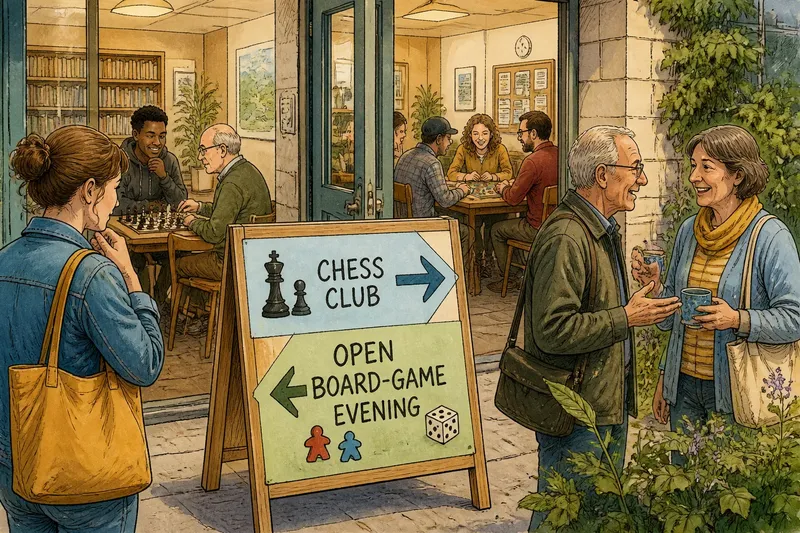
At the library door, a hand-lettered sign points one way to the chess club and another to an open board-game evening. If you are choosing between a club night or open meetup, the useful question is not which sounds friendlier; it is what kind of connection you want people to build. A recurring membership group and a drop-in gathering create different rhythms, and those rhythms shape who returns, what gets done and how conversation develops.
Regular attendance gives a group a shared thread
A club that meets on the same evening each week or month can carry an idea forward. Members may be learning a language, tending a community garden or rehearsing a play: each gathering picks up from the last. People recognise one another, remember earlier decisions and can take on tasks that need more than one visit.
That continuity is useful when the activity depends on familiarity. A book group can follow a longer reading list; a walking club can agree on routes and notice how local paths change. The group is less like a passing conversation and more like a shelf of labelled folders: each meeting leaves something for the next one to pick up.
The same rhythm asks something of participants. Members may need to reserve the evening, pay dues, attend an annual meeting or help organise a session. Those expectations can create a dependable core, but they can also make a casual interest feel like an obligation. Before setting them, distinguish what the activity genuinely needs from what is simply customary.
Drop-in meetups keep the threshold low
An open meetup lets people arrive when they can, without making a continuing promise. That suits residents with shifting shifts, caring responsibilities or curiosity about an activity they have not tried before. A café conversation, a casual sketching table or an informal repair gathering can be worthwhile even if the faces change from one date to the next.
Flexibility has a trade-off: newcomers may need the purpose explained each time, and projects can lose momentum if the people who know the background are absent. A meetup can still develop a familiar character, but it usually depends on simple, repeatable activities rather than decisions that require a stable membership.
Say a few residents want to organise a monthly litter-picking walk, but their weekends vary. They could announce an open Saturday route, share the meeting point and bring spare gloves; each gathering can focus on a manageable stretch. The observable result to look for is whether people can join without a long briefing and whether useful local tasks get completed, even when attendance changes.
Choose the format around the work, not the label
Start by asking what people will actually do together. If the activity needs practice, shared responsibility or decisions that build over time, a club format may fit. If the point is to meet neighbours, try something once or share a light activity without a continuing role, a drop-in format may be easier.
There is no need to treat the choice as permanent. A group can begin with open sessions and later invite regular participants to form a committee, or a club can hold occasional public evenings. Make the distinction clear in the invitation: “come when you can” means something different from “members meet regularly and share tasks”.
- Continuity: Does each gathering depend on what happened before?
- Commitment: Is regular attendance essential, or merely helpful?
- Coordination: Will someone need to maintain records, equipment or a shared plan?
- Access: Could a newcomer understand the activity without knowing its history?
- Capacity: Can a small organising team keep the format going?
These prompts are not a scorecard. They help reveal which arrangement makes the activity easier to sustain without asking more from participants than the purpose requires.
Make expectations visible before people arrive
For a club, explain how often it meets, what membership involves and whether people can attend a trial session. Say plainly if members are expected to take turns hosting or to contribute materials. If the group has a fee or formal rules, point readers to the relevant details rather than leaving them to discover them at the door.
For a meetup, state whether people can come once, whether they should bring anything and what happens if they arrive late. “Drop-in” should describe the real arrangement, not disguise an activity that requires advance preparation or a role each time. Clear wording helps people decide whether the gathering fits their week.
Keep the first meeting’s practical information close to the invitation: venue entrance, accessibility details, contact method and the name of the person to ask for. A friendly format still needs a clear landing place. This is about orientation, not a separate welcome programme; someone should be able to find the room and understand what is happening.
What should you ask before choosing a group format?
Can a drop-in meetup build lasting connections?
Yes, repeated open gatherings can help people recognise one another without requiring attendance every time. A consistent place, activity and schedule give returning participants a thread to follow while leaving room for occasional visitors.
When does a club need membership?
Membership can make sense when the group shares ongoing responsibilities, manages resources or needs a reliable way to make decisions. Keep any formal requirements proportionate to the activity, and explain them before someone joins.
Can a group combine club nights and open meetups?
It can, provided each event has a clear purpose. For example, members might handle planning at a regular club night while a separate open session welcomes anyone to try the activity.
What if attendance changes from meeting to meeting?
Choose activities that still work when the group is smaller or includes unfamiliar faces. If essential decisions or specialist knowledge are regularly missing, consider a smaller recurring core alongside open gatherings.
Let the format follow the kind of connection you want
A club night gives people a reason to return and a place to carry shared work forward. An open meetup makes room for unpredictable schedules and low-pressure participation. Some neighbourhood groups need one; others benefit from a mixture, with the responsibilities kept distinct.
When you describe a club night or open meetup, be specific about what people can expect and what the group asks in return. That small piece of honesty is often the most useful invitation: it lets someone choose not only whether to come, but whether this is a connection they can realistically keep.